Frequently Asked Questions
About the NKCC and Nederlandse Kooikerhondjes
Questions about the NKCC
Why should I be a member of this club?
To connect with other interested owners and pets, to learn more about the breed, to gain information on related events in your area, and to view opportunities to enhance the breed in Canada.
Is this club only for people that compete with their dogs?
NO! This club is based on a commitment to all Kooikers in Canada. They are all, first and foremost, our pets. Some people choose to compete with them because they are so intelligent and agile. That doesn’t make them any more essential to our club than the people who have dogs that love to snuggle in bed, or compete for couch space, or act as foot warmers in the winter. Everyone is welcome to share the joys and the challenges of owning a Kooiker. Our dogs are special and we all should appreciate it when others allow us to celebrate with them.
How can I become more involved in the club?
Thank you for asking! This club can’t run without volunteers. You don’t need to be an expert on anything, just be willing to share your time and your opinions. On the membership form, there is a box you can tick off to indicate your interest. At any time of the year, however, feel free to reach out to someone listed in the contact list and we will gladly accept your help. Different ways of helping include: becoming a board member, reaching out to members for various tasks, organizing material, researching products, creating content for the website or potential newsletters, offering up new ideas and suggestions on how to improve things, becoming a local contact for people interested in the club – so many possibilities!
Can I pay by cheque?
Yes, you can pay by cheque, however non-Canadians will have to make the cheque payable in Canadian funds. It is also possible to use an international money order in Canadian funds.
I am international, how do I pay for a membership?
With our website, we are now able to accept payment by US credit cards.
Are Kooikerhondjes recognized in Canada yet?
No, the Nederlandse Kooikerhondje breed is not yet recognized by the Canadian Kennel Club (CKC). An application has been submitted for recognition and there is an expectation that they will become part of the Miscellaneous class in 2026. Once they achieve Miscellaneous class status there is a plan to go through the process required for them to become part of the CKC Sporting dog class. They are however recognized with the American Kennel Club.
Can these dogs compete in conformation/performance in Canada?
Kooikers cannot currently compete in conformation events under the Canadian Kennel Club (CKC), but they can compete in CKC performance events as Unrecognized Purebred Canine Companions. (If you have any questions on how to register your Kooiker for performance events, please contact an NKCC club director for assistance.) There are also several other organizations and lots of different sporting events that Kooikers can compete in, including events held by the United Kennel Club (UKC). With a UKC number, Kooikers can compete in Conformation and many other sports as well!
General Information on the Breed
Why have I never heard of this breed before?
Although Kooikerhondje’s are an older Dutch breed, they are fairly new to North America. They were recognized by the AKC in 2018 and have enjoyed a rush of popularity since.
Sounds like the perfect dog – what’s the catch?
The number of Kooikerhondje breeders are limited in Canada, so puppies are not super easy to obtain. (You can find a list of Breeders here…. INSERT LINK TO BREEDERS PAGE). Choosing a reputable Breeder is highly recommended as puppies need to be well socialized when young.
How many Kooikerhondje’s are in Canada?
The breed is a fairly recent introduction to Canada, and numbers are steadily increasing. We estimate there are currently approximately 70 Nederlandse Kooikerhondjes in Canada (Nov. 2025).
Is there a Kooiker Rescue?
There currently is no Kooiker Rescue organization in Canada. Please contact our President if you need that service.
I have heard of a Tri Kooiker – what is that?
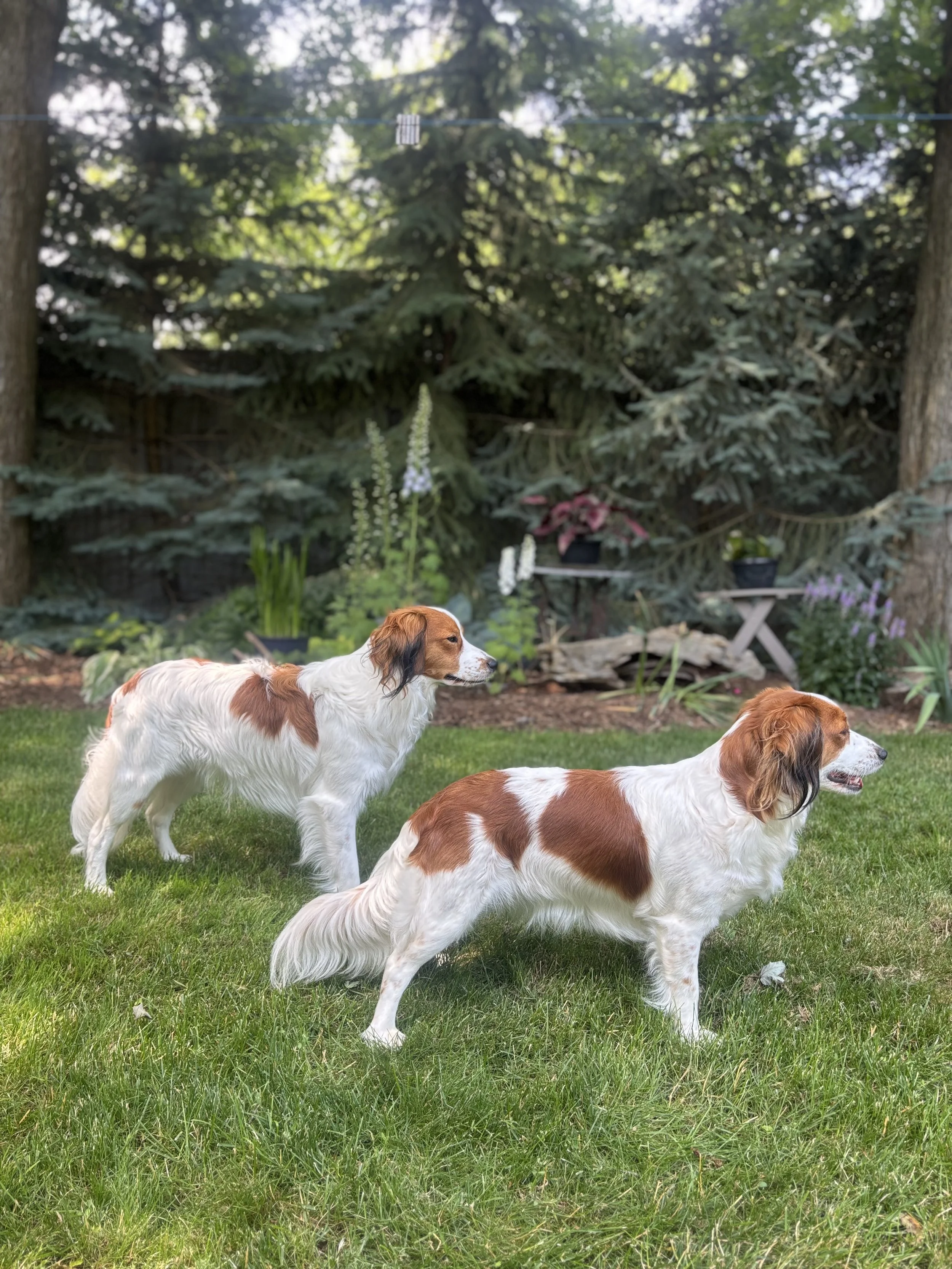
There is a (relatively rare) gene in Kooikers that causes the dog to have fur with black plates instead of red ones. These dogs also have some red markings, usually in the face, hence the name “Tri colour”. These dogs are not eligible for breeding.
Do they have any major health issues?
As with all breeds, the Kooikerhondje has some health issues. Good breeders will use genetic and veterinary testing to eliminate or significantly reduce these health issues. Make sure you discuss these tests with your breeder. For more information on specific diseases in the breed look INSERT LINK TO HEALTH OF KOOIKERS PAGE.
What are they bred to do?
In the Netherlands, the Kooikehondje was originally bred to work with his owner to lure ducks into an enclosure called “de kooi” (decoy). Once in the kooi, the dog’s owner could capture the ducks, either for the table, or, more recently, for nature management purposes. The dog was also trained to keep the farm around the capture area free of rodents.
Are they a hunting dog?
The Kooikerhondje is not typically used for hunting but some owners have been known to use them for similar work that other spaniel type dogs are bred for, such as flushing birds. Although very rare, some are also used to retrieve birds.
Kooiker Characteristics
What is their life span?
The Nederlandse Kooikerhondje has an expected life span of about 12-15 years. That being said, there are many that live even longer.
What is the difference between male and female?
Typically, male Kooikers tend to be bigger than females and they may have a more profuse coat. The male may be more stable in character, but he sometimes will have a tendency to question the leadership of his owner more. However, with a consistent approach, this can easily be avoided.
What is their size?
They are a small to medium sized breed.The Kooikerhondje commonly weighs in between nine and fourteen kilograms (about 19 to 30 lbs). Female dogs usually are at the lower end, male dogs usually at the top end of the range. Remember that some dogs can be larger or smaller. The Kooikerhondje commonly measures between 35 to 43 centimeters (14 to 17 in) at the withers. Female dogs usually are at the lower end, male dogs usually at the top end of the range. Remember that some dogs can be larger or smaller.
Are they a good family dog?
Yes, they are sweet companions, highly connected and devoted with their family. Family children should be well supervised at the onset. Although faithful to their family, Kooikerhondjes are typically very wary of strangers.
It is also important to note, however, that if circumstances in the house make the rules ambiguous or unpredictable to the dog, a Kooikerhondje may start making up his own rules all too quickly. For this reason, it is often suggested that this breed may not be suitable for a first-time dog owner.
When around children, proper training and supervision is important. Kooikers may respond to stressful or unpleasant situations in a canine way, which could mean growling or using their teeth to express displeasure. Since small children can provide unpredictable circumstances, understand the potential challenges before purchasing a kooikerhondje.
What is their energy level?
Kooikerhondje’s are clever, lively, cheerful, devoted, sweet companions in the home. Outdoors, they are a true sporting dog being keen, swift, tough, attentive and energetic, but not hyper. They do best with a fair amount of mental stimulation that supports their high intelligence. With sufficient perseverance and stamina, they will enjoy working and will do so with a cheerful character.
How much exercise do they need daily?
Kooikers should be exercised once or twice a day but they do have a lot of stamina so they would certainly be happy to be exercised more frequently than that. They do have an off switch so they are also more than happy to cuddle with their family members.
Do they shed?
This breed has a mild to average shedding coat. The Kooiker may shed their coat year round. Females may shed more than males. Brushing regularly will help to reduce the amount of hair left around the house or on your clothes, but it will not reduce it completely.
Are they easy to train?
Their cheerful personality, athletic build, intelligence, and eager-to-please attitude makes the Kooikerhondje a highly trainable dog. They have a strong drive and can be very determined, so they are best trained with a steadfast attitude and gentle hand to fulfill their promise as charming household pets and sporting companions.
How much grooming is needed?
Kooikerhondje’s are easy to care for, some say they are self-cleaning! Beyond regular weekly brushing, the occasional bath will keep the Kooikerhondje clean and looking his best. As per most dogs, the strong, fast-growing nails should be trimmed regularly, ears should be checked regularly to avoid a buildup of wax and debris and teeth should be brushed regularly.
Do they chase ducks?
Actually, the breed was never intended to chase ducks, but rather “lure” them. The ducks are intrigued by the flashy white plumed tail of the Kooiker as it goes along the waterways. If the Kooiker were to chase the ducks, the ducks would be more apt to fly away. Easy answer – no, a Nederlandse Kooikerhondje will probably not chase ducks.
Do they get along with cats or other pets?
If a pup is introduced to cats when young, they should get along just fine. Usually cats will offer up warning signs to puppies to let them know who is boss. If you are introducing a kitten to an adult dog, you should do your best to monitor the situation when they are together. Since Kooikers are keen to chase things, a kitten running away – or an adult cat for that matter – may trigger them to chase. With training, most will get along together just fine. Providing supervision so things don’t go too far and offering places for the cat to escape to will help with the learning process.
What is this I hear of them being Rodent dogs?
The nature of the historic work for this small sporting breed means that they have prey drive and energy along with the sensitive character of a spaniel.They are known as "rattlers" or "ratter dogs" due to their ability to effectively hunt and eliminate rodents like rats and mice.
Are they low-allergen?
The Kooikerhondje does not have a low allergen coat type.
Are they protective for security?
While Kooikers will definitely bark to alert you to strangers coming near, they aren’t very likely to attack the intruder. If you are looking for “all bark and no bite”, this might be the breed you are looking for
Do they bark a lot?
The Kooikerhondje is an active and alert dog. They will interact with their environment, and will tell you when there is something going on. Barking tends to be not excessive and can be influenced by training.
Health Testing – What is required?
For the Kooikerhondje, Genetic tests are recommended for Von Willebrand Disease (VWD), Hereditary Necrotising Myelopathy (ENM), or Kooiker Paralysis, and for (Poly)myositis). DNA testing for Von Willebrand’s disease, Hereditary Necrotising Myelopathy, Polymyositis and the Genotyping for Fit2breed, will now be performed by Van Haeringen Laboratories (VHL) from cheek swabs.
In North America it is recommended that all breeding dogs have a CHIC number from the Orthopedic Foundation for Animals (OFA) at ofa.org. The requirements for a CHIC number are for tests to be completed for hip dysplasia, patella luxation, hereditary eye diseases, and have completed genetic testing for VWD and ENM. See full details in the Health Section.
Do you have questions specifically on finding a puppy? See more FAQ’s in the breeders section.