Breed History
How This Impressive Breed Came To Be
One Person is Responsible for Preserving this Breed!
It is due to the determination of Mrs. M.C.S. Baroness van Hardenbroek van Ammerstol that the Kooikerhondje is what we see today.
In the 1940’s, her impetus was responsible for preserving the Kooikerhondje and developing it into a definitive breed. With the help of a peddler, to whom she gave a lock of the distinctly coloured hair and a picture of a Kooikerhondje, she succeeded in finding some useful specimens that matched the concept of the breed throughout the countryside. That’s how she found the bitch “Tommie” from Friesland. She is generally regarded as the founding mother of the current Kooikerhondje.
The first litter was bred by the Baroness in 1942 and was named “Van Walhalla”. Nico, a grandchild of Tommie’s granddaughter Carlienke van Walhalla, was the first Kooikerhondje to be admitted to the Provisional Register.
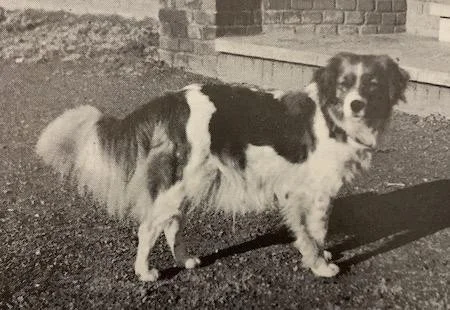
“Tommie” - The founding dam of today’s Kooikerhondjes
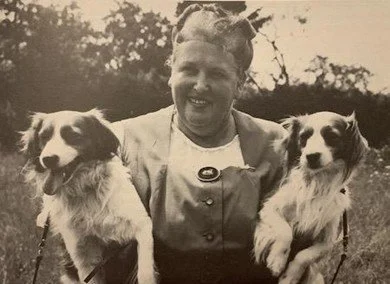
Mrs. M.C.S. Baroness van Hardenbroek van Ammerstol
Breed Recognition
IN THE NETHERLANDS:
Final breed recognition was given by the Dutch Kennel club on December 20, 1971. At this point, the current FCI breed standard came into effect. This standard is the basis for the US standard. The Canadian breed standard is currently being considered by the CKC.
IN THE USA:
The Nederlandse Kooikerhondje was recognized by the American Kennel Club of the United States in 2018.
IN CANADA:
The process of having the breed recognized in Canada was begun by a dedicated group of Kooikerhondje lovers in 2023, with the official submission being presented Oct. 30, 2024. At this point, recognition of the breed by the Canadian Kennel Club is under consideration with submission going through all of the necessary departments.
Unique Worldwide Documentation
In the Netherlands, a breeding registry, recording all litters born since the Baroness started breeding her dogs in 1942, has been maintained, and now includes litters from around the world. This registry also includes health information that is collected on individual dogs. There is a health survey and litter registration that is available and requested for all Kooikerhondjes. By contributing to this survey, a database is maintained in the Netherlands of all Kooikerhondjes. All owners are encouraged to work with their National Breed Club to allow this beneficial concept to continue.
The Nederlandse Kooikerhondje Club of Canada has a health survey form available to fill out for all Kooikers living in Canada, as well as documents to fill in regarding litters born in Canada.
The Working Kooikerhondje
Duck(s) = eend(en), decoy = (de) kooi.
The Dutch name “Kooikerhondje” actually means “dog of the decoy man” or “decoy dog”. Duck decoys are originally a Dutch invention and known in its current form for over 600 years.
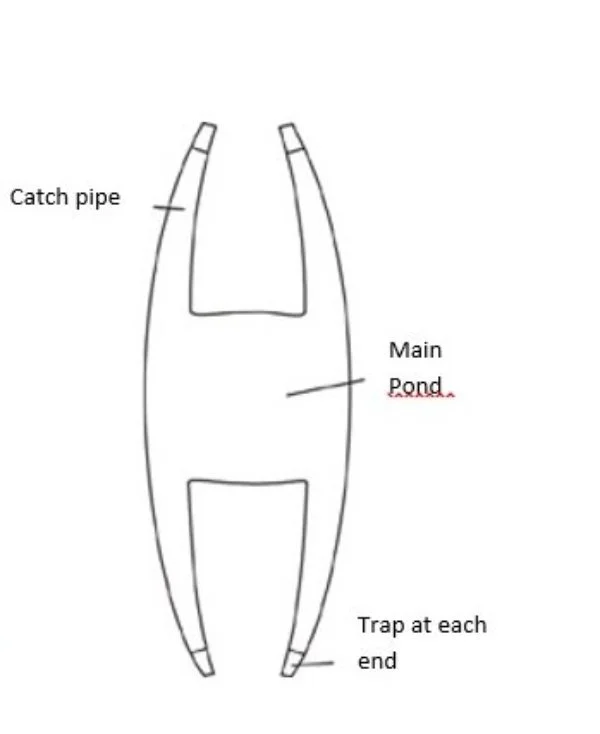
The name of the Kooikerhondje is irrefutably connected to the “eendenkooi” or duck decoy. The decoy referred to here is not the fake ducks that we normally relate to the word. Instead, in this case it refers to a combination of waterways created in a set “H” pattern, blinds or screens built along the water to hide the hunter and the dog, and a center pond.
The Decoy Dog
The original decoy premise is a unique co-operation between the ducks, the decoy man and the Kooikerhondje. It is a typical example of catching birds with birds, a pure form of bait hunting. (This is where the concept of “duck decoys” actually comes from.) It requires quite a lot of dedication, patience and professional knowledge, especially about the behaviour of ducks and the dog. Peace and quiet are very important.
Since the decoy man was not able to catch the ducks on his own, he got assistance from the Kooikerhondje. In history, they were described as multi-coloured dogs with a colour varying from yellow to orange. Old engravings show both long-haired and short-haired dogs. This indicates there was no exact breed type in the beginning. Since the most important thing for the decoy man was the effectiveness of the dog; that was the priority for breeding selection.
Important Criteria for a “Decoy Dog”
Not too big
Active
Not too noisy
Attentive
Well capable of learning things
Able to work on their own
Good gaiting, able to make sharp turns
*Many of these are still qualities we see in the breed today!
What Does a Duck Decoy/Eendekooi Look Like and How Do They Work?
Most of us in Canada have never heard of this concept. Let’s try to work through it.
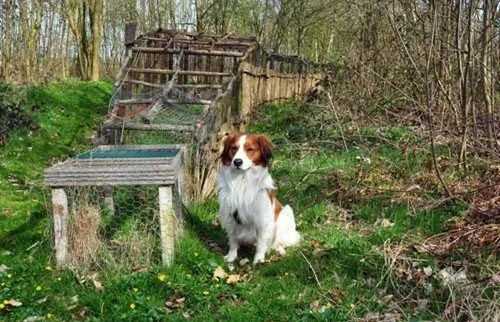
A duck decoy, or eendekooi, consists of a center pond with side-arms connected to it – forming a rounded H-shape. Most of the time the pond in the center would be surrounded by a bushy area, which creates peace and quiet in the pond and also functions as wind protection. The side-arms, or catch pipes would be curved ditches, with traps at each end of them to collect the ducks.
These narrow catch pipes are now often covered with netting, but originally they would have thorn bushes surrounding them. Both methods serve to prevent the ducks from flying away once they enter the arm.
On the land, there are several screens along the sides of each arm or pipe. The screens, mostly built of reed mats, are arranged in a broken design, making it possible for the decoyman and his Kooikerhondje to move freely behind these screens without the ducks noticing.
Each eendekooi would have a flock of ducks that live there permanently. These are called the decoy ducks. They live in the pond, with the catch pipes as their natural habitat. Since the resident ducks are comfortable swimming amongst the various pathways to be rewarded with food, they help to encourage the wild ducks to follow them into the desired pipe.
Very Clever!
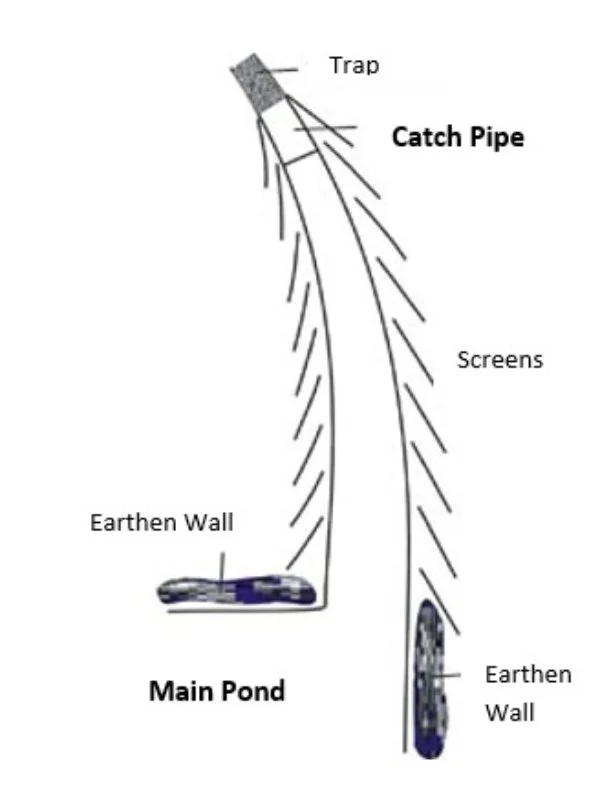
Method of Catching Ducks
When time came to trap the wild ducks, the decoy man would select the best catch pipe, depending on the wind direction; quite important as ducks will usually fly into the wind.
Once the decoy man chose the correct pipe, he would throw some food in it. The decoy ducks were used to this and would swim towards the food, and the wild ducks would follow along.
This is when the Kooikerhondge would start working. With instructions from its master, the Kooikerhondje travels back and forth behind the screens. Every once in a while the ducks can see the white plumed tail happily waving. Out of curiosity, they follow the dog further along the catch pipe. When the ducks are far enough along the pipe, the decoy man shows up to startle them, causing the ducks to fly even further down the waterway. At this point, the decoy ducks, knowing the game, make their way back to the pond.
The wild ducks, however, are not able to see the original pond anymore because of the curve, so they swim towards the light at the end of the pipe, where the vegetation is kept cut back. Once the ducks swim far enough that they have entered the trap box at the end, it would be closed by the decoy man. The wild ducks are caught and the resident tame ducks remain to repeat the process the next time.
There are still approximately 100 eendekoois in The Netherlands. Most of them are now involved in scientific research involving ducks.
In some cases, the decoy man still gets assistance from a Kooikerhondje.
Based on information from the Vereniging Het Nederlandse Kooikerhondje; originating breed club of the Netherlands Kooikerhondje
Breed Traits in Today’s Kooikers
While we won’t find an eendekooi in North America, we can utilize the history and original make up of the breed to see how they will perform in our lifestyle.
The Kooikerhondje was originally a working dog. In addition to their work in duck decoys, these dogs were expected to patrol the farm and be the guard of the house and garden - serving as a watchdog to warn of intruders or predators and to hunt mice, moles, rats and other vermin
What does that mean for today’s Kooikerhondje? Let’s break it down.
“Working Dog” This means you have a dog that wants to work with you. Kooikers also need a job to keep them busy and entertained. This is one of the reasons you see them excel in performance sports! They are working with their owner and doing a “job”.
If you don’t encourage them to use their mind, they may find their own jobs to do around the house to keep them busy and entertained, which might involve behaviours that are not quite so favourable in your mind. Consider activities like obedience training, agility, scent work, trick training, etc. The possibilities are almost endless! Your Kooiker will love to work with you, and their active mind will thank you.
Since much of the work with the decoy man involved silent communication so as not to alert the ducks, this breed excels at reading the body language and hand signals of its owner. It just comes naturally to them. Can you see the benefit this might have in an agility field?
“Expected to Patrol the Farm” This means you have a dog that is on the look out for strangers and possible problems. This is where the “will bark to alert” part of the breed description comes in. The Kooikerhondje is not an attack dog, but if someone comes onto your property, you can expect to be notified of it. They are not a yappy dog, but will let you know when strangers appear.
“Guard of House and Garden” With the presence of the resident ducks on the farm, having vermin present that would eat the duck eggs would be a problem. Another part of the Kooikerhondje’s job was to patrol the area for mice, rats and other creatures. Today, Kooikers are still invested in this job. They will seek out rodents and do their best to keep them at bay. This might include the neighbourhood squirrels as well!
Kooikerhondjes Portrayed in Art
Paintings by 17th century masters, including Jan Steen, often show us small spaniel-like dogs that are very similar to the present-day Kooikerhondje. These dogs are also seen in 18th and 19th century family portraits.
While the concept of dog “breeds” was not the same then as it is now, scholars referred to these small dogs as “spions”. Many artists from long ago were famous for giving glimpses of “life moments” as the artists saw it. These small Kooiker-like dogs were portrayed as a normal part of life in the Netherlands.
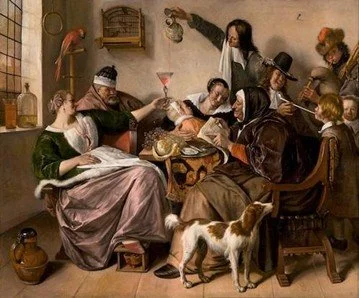
The Way You Hear It
Jan Steen 1663-1665
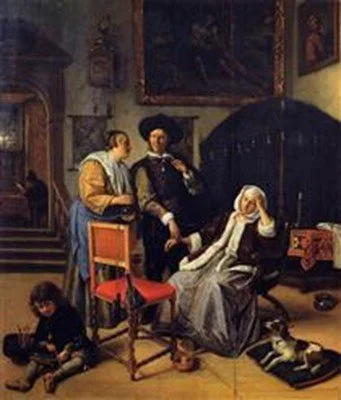
Doctors Visit
Jan Steen 1661-1662
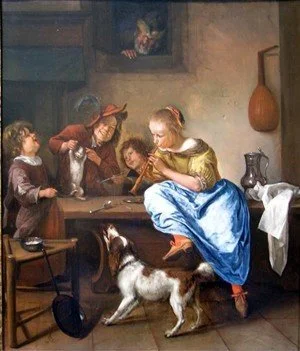
Dancing Lesson
Jan Steen 1660-1679
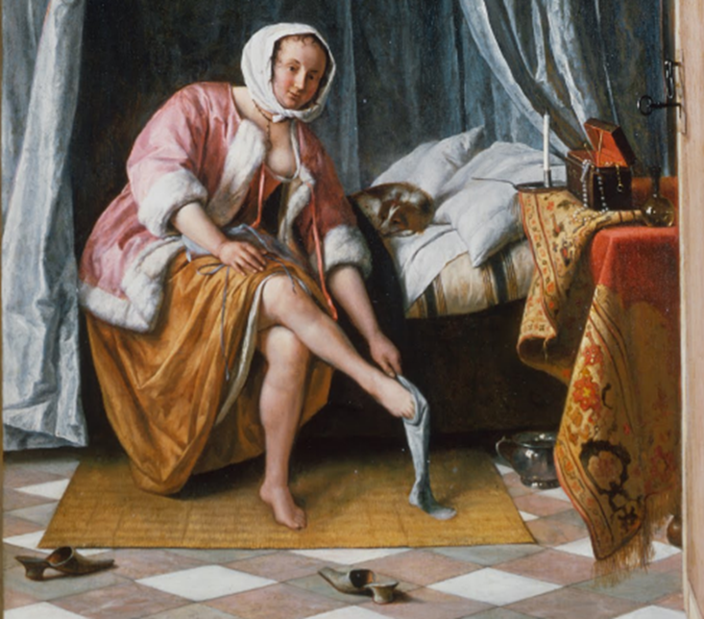
Woman at Her Toilet
Jan Steen 1663
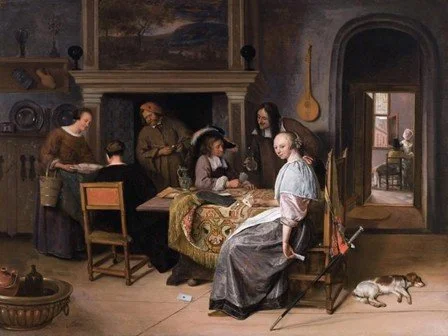
The Card Players in an Interior
Jan Steen 1660
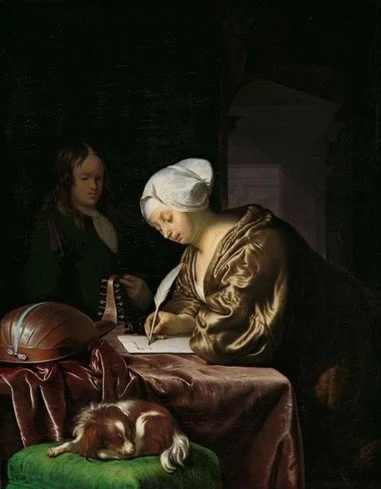
The Letter Writer
Frans van Mieris 1680
”This little dog show both the plumed tail as well as the black ear rings”
Contact us
Interested in the breed or need more information?
Fill out some info and we will be in touch shortly.